Divorce rates in Nepal have increased significantly in recent years, rising from less than 1% in the 1990s to approximately 4-5% today.
While still low compared to Western countries, this represents a major shift in Nepali society. At Haven Law Groups, we understand that behind every divorce statistic is a personal story of marital breakdown. Understanding the common causes of divorce in Nepal is essential for preventing unnecessary separations and navigating the legal process when marriage dissolution becomes inevitable.
This comprehensive guide examines the primary causes of divorce in Nepal, the legal framework under the National Civil Code 2074 (2017), and how Haven Law Groups helps clients address these challenges.
Understanding Divorce Trends in Nepal
The landscape of marriage in Nepal is changing rapidly. Recent data shows that 85% of divorce cases in Karnali Province are filed by women,
reflecting a dramatic shift from the past when women rarely initiated divorce due to social stigma and economic dependence. In Kathmandu, divorce rates have doubled between 2005 and 2012, and this trend continues across urban areas.
Key Statistics:
- Current divorce rate: 4-5% of marriages
- Women filing for divorce: 85% in some regions
- Fastest growing demographic: Urban, educated women aged 25-35
- Average marriage duration before divorce: 5-7 years
At Haven Law Groups, we’ve observed these trends firsthand, with increasing numbers of clients seeking legal guidance for marital dissolution.
Top 10 Common Causes of Divorce in Nepal
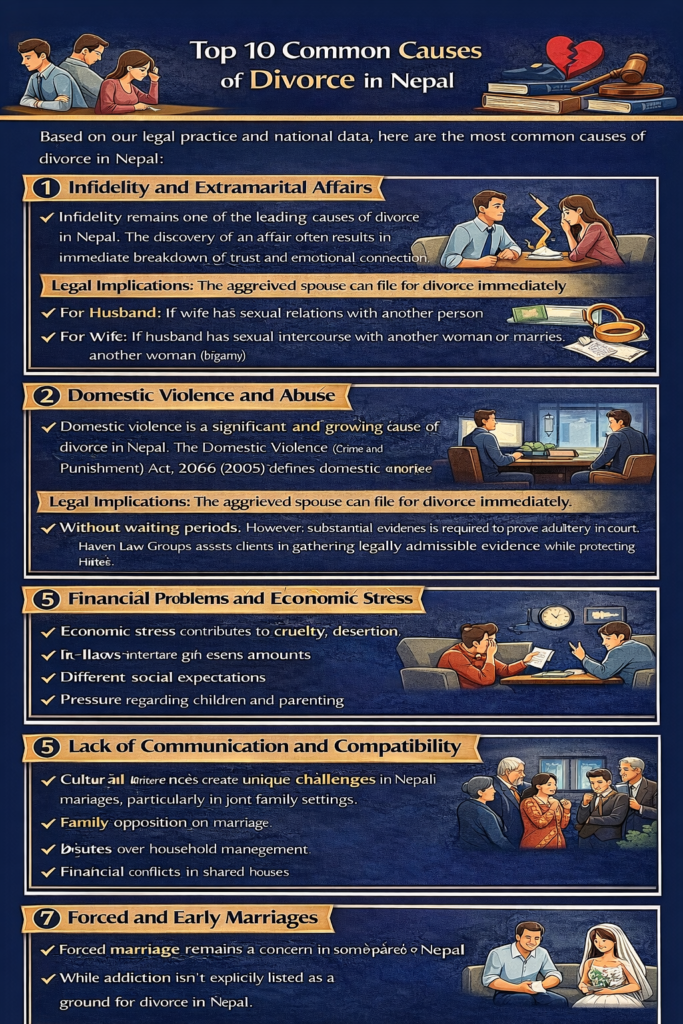
Based on our legal practice and national data, here are the most common causes of divorce in Nepal:
1. Infidelity and Extramarital Affairs
Infidelity remains one of the leading causes of divorce in Nepal. The discovery of an affair often results in immediate breakdown of trust and emotional connection. Under Section 94 and 95 of the National Civil Code 2074, adultery is explicitly recognized as grounds for divorce:
- For Husband: If wife has sexual relations with another person
- For Wife: If husband has sexual intercourse with another woman or marries another woman (bigamy)
Legal Implications: The aggrieved spouse can file for divorce immediately without waiting periods. However, substantial evidence is required to prove adultery in court. Haven Law Groups assists clients in gathering legally admissible evidence while protecting their rights.
Why It’s Increasing: Foreign employment, social media connections, and changing social attitudes have contributed to rising infidelity case.
2. Domestic Violence and Abuse
Domestic violence is a significant and growing cause of divorce in Nepal. The Domestic Violence (Crime and Punishment) Act, 2066 (2009) defines domestic violence broadly, including:
- Physical abuse and assault
- Mental and emotional torture
- Sexual violence (including marital rape)
- Economic deprivation and control
Legal Protections: Under the National Civil Code 2074, cruelty causing “grievous hurt or severe physical or mental pain” is grounds for divorce. Additionally, victims can seek:
- Protection orders from court
- Immediate police intervention
- Medical and legal assistance
Haven Law Groups specializes in handling domestic violence cases with sensitivity and urgency, ensuring client safety while building strong legal cases.
Trend: Increased awareness and legal empowerment have led more women to seek divorce as a means of escaping abusive relationships.
3. Foreign Employment and Long-Term Separation
Foreign employment has emerged as one of the main causes of divorce in Nepal. With over 4 million Nepalis working abroad, prolonged separation creates multiple marital stressors:
- Trust issues and infidelity: Extended absence leads to suspicion and actual extramarital affairs
- Financial conflicts: Misuse of remittance money by either spouse
- Emotional disconnect: Years of separation erode marital bonds
- Changed perspectives: Exposure to different cultures and lifestyles alters expectations
Legal Grounds: Separation for 3+ consecutive years without consent is explicit grounds for divorce under Sections 94 and 95 of the Civil Code.
Haven Law Groups provides specialized services for NRN (Non-Resident Nepali) divorces, handling cases through Power of Attorney when clients cannot be physically present in Nepal.
4. Financial Problems and Economic Stress
Financial difficulties are a major underlying cause of marital breakdown in Nepal. While not explicitly listed as a standalone ground for divorce, economic stress contributes to other recognized grounds:
- Cruelty: Financial deprivation or refusal to provide maintenance
- Desertion: Abandonment due to inability to support family
- Conflict: Constant arguments over money management
Legal Considerations: The court examines financial circumstances when determining:
- Alimony and maintenance amounts
- Property division
- Child support obligations
Haven Law Groups ensures fair financial settlements, protecting economically vulnerable spouses, usually women, through aggressive advocacy for property rights and maintenance.
5. Lack of Communication and Compatibility
Communication breakdown is a pervasive but often overlooked cause of divorce. While not a specific legal ground, lack of communication leads to:
- Emotional distance and resentment
- Unresolved conflicts escalating into cruelty
- Irreconcilable differences
- Mutual consent divorce when both parties recognize the marriage is unsalvageable
Modern Challenge: Changing expectations in relationships, influenced by Western media and education, have raised the bar for marital satisfaction. Younger couples are less willing to tolerate unhappy marriages.
Haven Law Groups recommends mediation and counseling before pursuing divorce, but when reconciliation fails, we facilitate smooth mutual consent divorces that minimize conflict.
6. Inter-Caste and Inter-Religious Marriage Pressures
Cultural differences create unique challenges in Nepali marriages, particularly in inter-caste or inter-ethnic unions. Nepal’s diverse cultural landscape means couples face:
- Family opposition and interference
- Conflicting religious practices
- Different social expectations
- Pressure from extended family
Legal Status: While cultural differences aren’t explicit grounds for divorce, they often contribute to:
- Cruelty: Family harassment causing mental pain
- Mutual consent: Couples agreeing to separate due to unbearable pressure
Trend: Inter-caste marriages have higher divorce rates due to ongoing social pressures.
7. Family Interference and Joint Family Conflicts
Family interference is a significant factor in Nepali divorces, particularly in joint family settings. Common issues include:
- In-laws interfering in marital decisions
- Disputes over household management
- Financial conflicts in shared households
- Pressure regarding children and parenting
Legal Perspective: While family interference itself isn’t a legal ground, it often constitutes cruelty if it causes severe mental pain or leads to expulsion from the marital home.
Haven Law Groups has extensive experience handling complex family dynamics, ensuring our clients’ rights are protected even when extended families are involved.
8. Addiction and Substance Abuse
Addiction, particularly to alcohol and drugs, is a growing cause of divorce in Nepal. While addiction isn’t explicitly listed as a ground, it leads to:
- Cruelty: Substance abuse often results in domestic violence and neglect
- Financial problems: Money spent on addiction deprives family of necessities
- Desertion: Emotional abandonment even when physically present
Legal Strategy: Haven Law Groups helps clients document how addiction has caused cruelty or deprivation, building strong cases for divorce and protection.
9. Forced and Early Marriages
Forced marriage remains a concern in some parts of Nepal and contributes to later divorce. The National Civil Code 2074 recognizes:
- Automatic divorce if marriage was performed without full consent
- Annulment options for marriages entered under coercion
Early Marriage Impact: High rates of early marriage in regions like Karnali Province lead to divorces when couples reach emotional maturity and seek independence.
Haven Law Groups assists victims of forced marriage in securing legal dissolution and protecting their rights.
10. Infertility and Childlessness
Infertility can create significant marital strain, particularly in Nepali society where having children is often considered essential to marriage. While the law requires medical evidence to prove infertility as a ground, the stress of childlessness often leads to:
- Blame and resentment between spouses
- Family pressure and interference
- Mutual consent divorce when couples cannot resolve conflicts
Legal Approach: Haven Law Groups handles these sensitive cases with discretion, ensuring medical privacy while advocating for our clients’ rights.
Legal Grounds for Divorce in Nepal: How Haven Law Groups Can Help
Understanding the legal grounds for divorce is crucial. The National Civil Code 2074 provides specific provisions:
Grounds for Divorce (Husband):
- Wife living separately for 3+ years without consent
- Wife depriving husband of maintenance or expelling him
- Wife causing grievous hurt or severe mental/physical pain
- Wife having sexual relations with another person
Grounds for Divorce (Wife):
- Husband living separately for 3+ years without consent
- Husband depriving wife of maintenance or expelling her
- Husband causing grievous hurt or severe mental/physical pain
- Husband marrying another woman (bigamy)
- Husband having sexual intercourse with another woman
- Husband raping or attempting to rape the wife
Mutual Consent Divorce:
Both parties can agree to divorce at any time without proving fault.
Haven Law Groups provides expert legal consultation to determine the strongest grounds for your specific situation, ensuring the best possible outcome.
The Divorce Process in Nepal: Step-by-Step
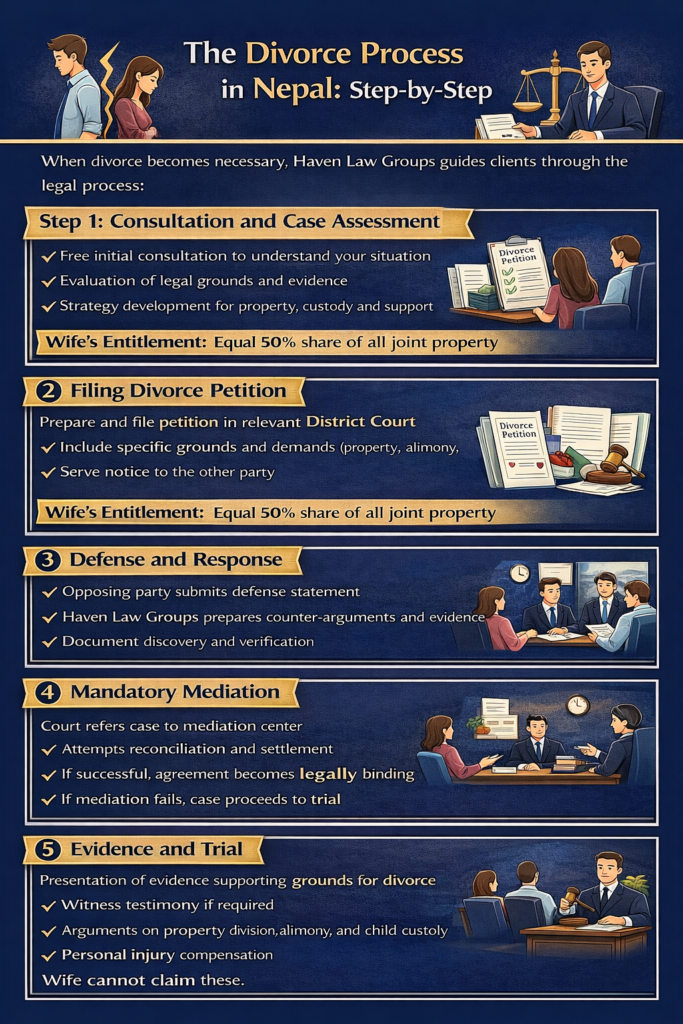
When divorce becomes necessary, Haven Law Groups guides clients through the legal process:
Step 1: Consultation and Case Assessment
- Free initial consultation to understand your situation
- Evaluation of legal grounds and evidence
- Strategy development for property, custody, and support
Step 2: Filing Divorce Petition
- Prepare and file petition in relevant District Court
- Include specific grounds and demands (property, alimony, custody)
- Serve notice to the other party
Step 3: Defense and Response
- Opposing party submits defense statement
- Haven Law Groups prepares counter-arguments and evidence
- Document discovery and verification
Step 4: Mandatory Mediation
- Court refers case to mediation center
- Attempts reconciliation and settlement
- If successful, agreement becomes legally binding
- If mediation fails, case proceeds to trial
Step 5: Evidence and Trial
- Presentation of evidence supporting grounds for divorce
- Witness testimony if required
- Arguments on property division, alimony, and child custody
Step 6: Final Judgment
- Court issues divorce decree
- Orders on property partition, maintenance, and custody
- Haven Law Groups ensures enforcement of orders
Timeline: Mutual consent divorces take 2-7 days; contested divorces take 1-3 years.
Why Choose Haven Law Groups for Divorce Cases?
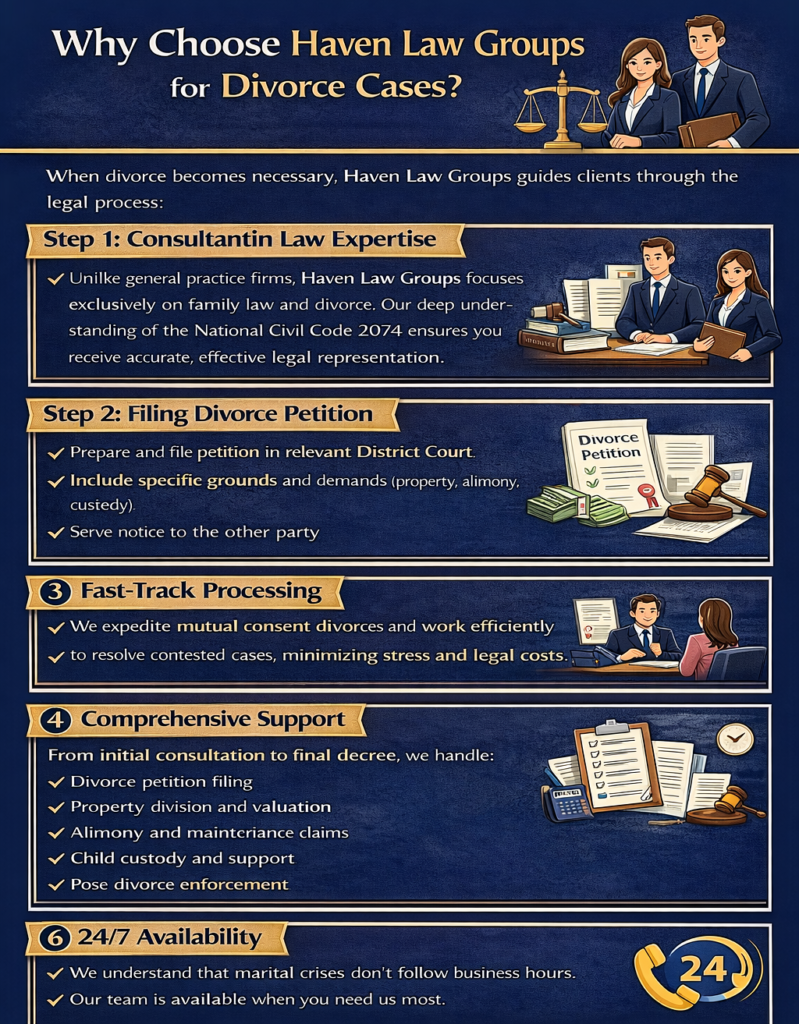
Specialized Family Law Expertise
Unlike general practice firms, Haven Law Groups focuses exclusively on family law and divorce. Our deep understanding of the National Civil Code 2074 ensures you receive accurate, effective legal representation.
Gender-Sensitive Approach
We recognize that divorce impacts women and men differently in Nepali society. Our team provides tailored support that addresses the unique challenges faced by each client.
Fast-Track Processing
We expedite mutual consent divorces and work efficiently to resolve contested cases, minimizing stress and legal costs.
Comprehensive Support
From initial consultation to final decree, we handle:
- Divorce petition filing
- Property division and valuation
- Alimony and maintenance claims
- Child custody and support
- Post-divorce enforcement
24/7 Availability
We understand that marital crises don’t follow business hours. Our team is available when you need us most.
Preventing Divorce: Legal Counseling and Mediation
At Haven Law Groups, we believe in preserving marriages when possible. We offer:
- Pre-divorce counseling to explore reconciliation
- Mediation services to resolve conflicts without litigation
- Legal advice on improving marital contracts and agreements
However, when divorce is inevitable, we ensure the process is fair, respectful, and protective of your rights.
Frequently Asked Questions About Divorce in Nepal
What is the current divorce rate in Nepal? The divorce rate is approximately 4-5% of marriages, up from less than 1% in previous decades.
Who files for divorce more often in Nepal?Women file 85% of divorce cases in some regions, reflecting increased empowerment and legal awareness.
How long does divorce take in Nepal?
- Mutual consent: 2-7 days
- Contested: 1-3 years
Can I get divorced if my spouse doesn’t agree? Yes. You can file for divorce based on specific legal grounds (cruelty, desertion, adultery, etc.) without spousal consent.
What evidence is needed for adultery? Substantial evidence such as photos, messages, witness testimony, or hotel records. Haven Law Groups advises on legally admissible evidence collection.
Can I claim property after divorce? Yes. Wives are entitled to equal share of joint property and can claim maintenance. Husbands may also claim property rights in certain circumstances.
Does domestic violence affect property rights? Yes. Victims of domestic violence often receive favorable property division and maintenance orders.
What happens to children in divorce? Courts decide custody based on children’s best interests, considering age, parental capability, and child preference (if over 10 years).
Contact Haven Law Groups Today
If you’re facing marital difficulties or considering divorce, Haven Law Groups is here to help. We provide compassionate, expert legal guidance to navigate Nepal’s divorce laws and protect your rights.
Whether you need help understanding your legal options, filing for divorce, or securing fair property settlement, our experienced team is ready to assist.
Schedule your free consultation today and take the first step toward resolving your marital issues with confidence and legal protection.
Disclaimer: This article is for informational purposes only and does not constitute legal advice. Divorce laws and procedures are subject to change. Consult with Haven Law Groups for current, case-specific guidance.
What are the main causes of divorce in Nepal?
Common causes of divorce in Nepal include domestic violence, infidelity, financial issues, and incompatibility between spouses. Changing social norms and increased awareness of individual rights also contribute to rising divorce rates.
Is infidelity a common reason for divorce in Nepal?
Infidelity is a significant factor in many Nepali divorce cases. Extramarital affairs breach trust and often lead to irreparable damage in marriages, prompting couples to seek legal separation.
How does domestic violence contribute to divorce cases in Nepal?
Domestic violence frequently drives divorce in Nepal. Physical, emotional, or psychological abuse by a spouse creates an unsafe home environment, compelling victims to pursue divorce for their wellbeing and safety.
Can financial problems lead to divorce in Nepali families?
Financial problems can strain Nepali marriages, potentially leading to divorce. Unemployment, debt, or disagreements over money management may cause conflicts that erode the marital relationship over time.
How do arranged marriages affect divorce rates in Nepal?
Arranged marriages in Nepal can impact divorce rates both positively and negatively. While some arranged unions benefit from family support, others may struggle with compatibility issues, potentially increasing divorce likelihood.
How do changing gender roles affect divorce rates in Nepal?
Evolving gender roles in Nepal influence divorce rates. As women gain more economic independence and social awareness, they may be more likely to leave unsatisfactory marriages, contributing to increased divorce rates.
What legal grounds are accepted for divorce in Nepal?
Accepted grounds include adultery, cruelty, desertion for 3+ years, severe mental illness, impotence, separate living for 3+ years, and mutual consent. Courts evaluate each case individually based on evidence presented.
Can family pressure or interference cause divorce in Nepal?
While not an official legal ground, family interference can contribute to marital discord. Courts may consider it alongside other factors if it severely impacts the relationship and one spouse seeks divorce.
Are mental health issues a factor in divorces in Nepal?
Severe mental illness lasting 3+ years with no prospect of recovery is a legal ground for divorce in Nepal. Milder conditions may be considered if they significantly affect marital life.